Musings of natural and human life along the world's urban waterways, with a focus on the Arroyo Seco and Los Angeles Rivers in Southern California.
Showing posts with label nature. Show all posts
Sunday, June 12, 2011
The Loss Of Open Space No One's Really Talking About...
We seem to be bombarded almost daily with these frightening headlines: State Parks to Close...Irvine's Wild Rivers Water Park to relocate to make way for an apartment complex...LA River projects on hold due to lack of funding.
Yet the most disturbing 'closures' are the places where many of us hold our first memories of childhood exploration in nature: The Summer Camp.
Throughout the country, Girl and Boy Scout Councils, church organizations, private families and civic organizations are doing the once unthinkable: closing their camps and putting the properties up for sale to raise revenue to keep their operations alive. More and more we are seeing large swaths of open space becoming abandoned by long-time property owners and tenants (as is the case of several camps within our National Forest system).
This trend is troubling for a number of reasons:
1. the great likelihood that these parcels will be purchased by those who intend to develop the land
2. the fact that many of these camps have learning-oriented recreational improvements in place that will likely be destroyed
3. the loss of 'one tank trips' to get families into nature during a time of economic turmoil
While this movement is nationwide, the example of one camp: Camp Sugarbush, where I spent much of my childhood as a Girl Scout camper, is illustrative of this sad trend.
Camp Sugarbush embraces almost 200 scenic wooded acres in rural Northeast Ohio and its name connotes the large stand of sugar maple trees growing in the area. This camp is highly improved with a lodge/dining hall, infirmary, heated swimming pool, small canoe lake, archery range, game fields, and an observatory. Overnight camping amenities include cabins, a primitive cabin, covered wagons (yes, you can sleep in them just like the pioneers did!), and perma-tents with cotting and mattresses. The lodge and cabin include flush toilets and hot showers (yay!). All other units have their own pavilion, latrine, and running water. The camp offers day camping, overnight camping and primitive camping options.
For me, Camp Sugarbush was more than just a place to hang out at during the summer. Here I learned ritual and survival skills that still serve me well today. Among my 'firsts' at Camp Sugarbush: first archery lesson, first primitive camping experience, first canoeing, first campfire singalong, and first leather tanning. I hated the sound of the bugle at 6:30am waking us up and calling us to the flagpole for the morning camp opening ritual but loved making s'mores over the campfire. I hated repelling the nasty mosquitoes buzzing around but loved our hikes in the woods, learning the names of plants and trees, while in search of 'edible' berries. I learned the difference between poison oak and poison ivy. I learned how to watch out for snakes (by the way, this is a skill that applies to human snakes, too). I learned how to catch frogs. I hated latrine duty but learned the connection between human waste and our watershed at a young age. I loved the ride and commaderie on the camp bus and can still smell the hickory smoked campfire air.
A couple months ago, the Girl Scout Council of NE Ohio voted to close Camp Sugarbush and four others, with the plan to sell them to raise funds to keep the organization financially sustainable, while reorganizing camping activities around two 'leadership centers.' But what will the final fate of this and many other camp grounds nationwide mean?
Born of the 'garden movement' at the turn of the 20th Century and nurtured as church groups and youth organizations such as the Boy Scouts, Girl Scouts, Campfire, and 4-H were founded and grew, the nature summer camp gave children and families the opportunity to leave the sooty, dirty industrial city where they lived and camp under the stars in nature. According to the American Camp Association, summer camps serve over 10 million Americans at 12,000 accredited campsites.
Only 10 million? No wonder these open spaces are quickly becoming endangered species. Despite the cries about nature deficient disorder in our children due to urban upbringing, fewer youth than ever are engaging in overnight camping away from home.
Several factors have led to this decline: the rapid urbanization of America where today more than half the population lives in cities, stressed out two-income and single parent families who are struggling just to financially survive, and computer-video game-virtual reality technology that entertains more and more of our children, just to name a few.
And here's the saddest part: unless you grew up in a camping family or attended camp as a child, you have probably forgotten how to camp and live outdoors. Anecdotally, I'm always surprised how, when I take visitors down to the Arroyo Seco in very civilized Pasadena, they quake in their shoes when I mention wild critters in the area, especially snakes.
While nature can be enjoyed just for nature's sake through hiking, bicycling, and horseback riding, natural camp grounds are critical playgrounds for learning skills of survival and skills of teamwork and leadership. Moreover, since most camp grounds are located on a freshwater river or stream, these natural playgrounds are a key source of watershed education, too
Whether it's state parks, public campgrounds or civic/church owned camp sites, we risk losing some of our most precious low impact recreational open space if we cannot develop new models of joint use, cross-organizational collaboration, and revenue enhancement. And where are the land conservancies? While conservancies focus on ranch, farm, and urban interface properties, I've yet to see an organized effort to acquire and conserve these precious camp lands.
This summer, take your loved ones camping before it's too late. Better yet, bring along a friend or two and introduce them to the joy and wonder of living, for at least a brief time, in nature.
Tuesday, May 31, 2011
Where Should the Sediment Go? The Devil's Gate Dam Dilemma
UPDATE 8/2/2011: The Pasadena City Council unanimously approves use of Johnson Field for sediment storage during LA County's interim project to remove sediment buildup behind Devil's Gate Dam.
-------------------------------------
To understand the current dynamics playing out in the Hahamongna about sediment removal behind Devil's Gate Dam, we must look at what got us to this point.
Here's a short recap:
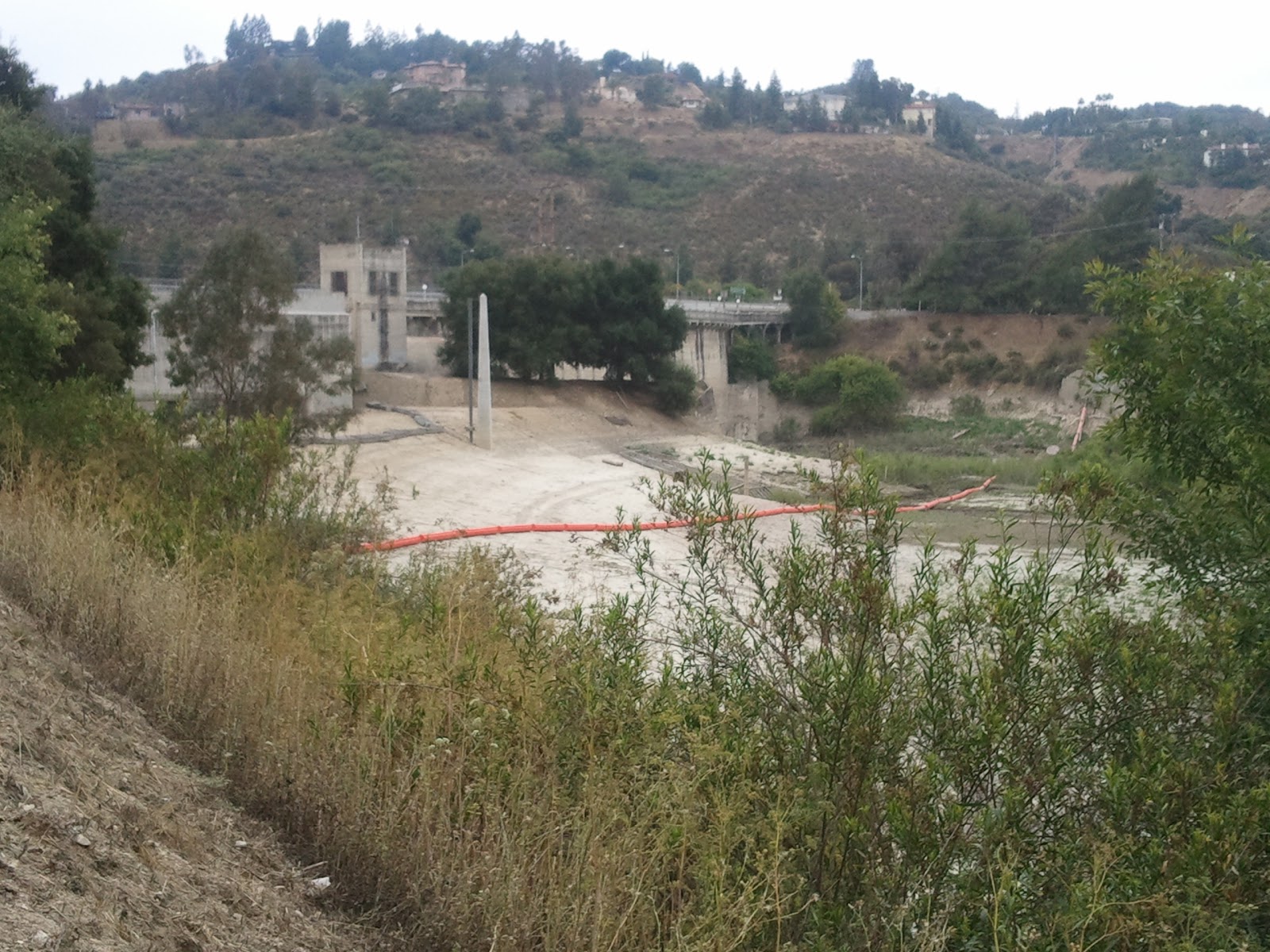
.The 2009 Station Fire wildfire burns almost 70% of the upper Arroyo Seco watershed, depositing over 1,000,000 cubic yards of sediment into the Hahamongna Basin, much of which collects behind Devil's Date Dam
.LA County plans to remove all sediment in the Basin under 'emergency' maintenance procedures which do not require an Environmental Impact Report
.The local environmental community protests and the LA County Board of Supervisors approves a resolution requiring a complete EIR be done before sediment removal occurs, with the exception that County Public Works can remove 25,000 cubic yards this summer directly behind the Dam because of emergency maintenance conditions.
.LA County Dept of Public Works finalizes its interim sediment measures and starts conducting community outreach meetings to review truck transportation routes to haul the sediment out of the Basin for relocation to Scholl Canyon.
.The interim sediment removal plan must be completed by October 15, 2011, when the annual rainy season traditionally begins.
Yet the controversy seems to go on....
Why?
First, while LA County has put together a generally sound interim sediment plan, it has failed in its ability to properly communicate this plan to the public. Case in point: last Thursday night's outreach meeting at La Canada High School to discuss the 'truck haul' plans. What didn't go wrong? The powerpoint did not work. There were no handouts. A new alternative #4 to keep the sediment in the Basin was announced with little context as to why this option was now being offered. Presenters seemed to be at a loss to directly answer many questions posed by the attendees.
But the enviro community and residents are not blameless here, either. Numerous bloggers, local residents and environmental organizations continue to disseminate skewed information and promote 20th Century style scare tactics online and in whisper campaigns to rally their troops towards either stopping this sediment removal or warning of 'dire' consequences if it occurs. They aren't offering any proactive alternative solutions, either.
So let's look at the facts relevant to public safety. (All these documents are online and available to the public at the dpw.lacounty.gov site.)
If you click on the header to this blog, you will be taken to the LA County Staff Report to the Board of Supervisors which accurately discusses the issues. Then take a look at the powerpoint for the interim removal plan here:
tp://dpw.lacounty.gov/wrd/removal/DevilGate/CVAC_Interim_Measures_20110525.pdf
When we cut to the chase these facts remain:
1. The sediment directly behind Devil's Gate Dam has reached a level of 1,009 feet
2. This sediment is blocking at least two sluice gates, which are responsible for releasing water through the flood gates.
3. This sediment is also close to clogging the outlet valves at the top of these sluice gates.
4. This sediment, if not removed this summer, will likely clog outlet valves, including tunnel water outlets after the next rainy season.
Clogged sluice gates and tunnel water outlets mean that the Watermaster will be unable to discharge water through the dam.
Here's the unknown: how much precipitation the Arroyo Seco watershed will get this rainy season. It's especially difficult to predict because we are now experiencing chaotic weather patterns, witnessed by Mississippi River flooding, deadly Southern tornados and a West Texas drought and fire storm. As one local example, the experts at NOAA predicted a 'dry' La Nina last year and we got instead one of the wettest seasons in recent years. Should we have another wet rainy season, even more sediment will flow into the Hahamongna, resting behind the Dam.
Based upon these facts, can we really afford to take the risk of doing nothing about sediment removal behind the Dam this summer?
Let's review the sediment removal 'haul out' options (see the map on the powerpoint link). Unfortunately, projects of this scope and type always have short-term negative impacts on the local community. Truck traffic with attendant noise over the 4 week haul out time period will inevitably be a short term nuisance to affected residents and local commuters (JPL, La Canada High students, park users).
It's totally understandable that residents are concerned about the County's initial preference to use Alternative Route #1 down Windsor Boulevard. For the County, it is the fastest route out and will require the minimal infrastructure work to get this job done. For years, these residents have dealt with the noise and congestion of heavy trucking on this roadway due to the La Vina development, the City of Pasadena's water treatment plant construction, and regular deliveries to JPL.
That's why the recent agreement between the County and the City of Pasadena Water and Power which makes the availability of Johnson Field, located on the northeast side within the Hahagmongna Basin, as a sediment removal holding site welcome news. Use of Johnson Field will decrease truck hauling by 80% since only 20% of the organic materials will have to be hauled out of the Basin itself. The remainder will be hauled to and 'stored' on Johnson Field, which has not been used as a playing field for years.
The local in-basin haul to Johnson Field will also support the short timeline the County has to move this buildup because sediment needs to be 'dried out' first before it can be relocated due of its heavy weight when saturated by water.
Ultimately, there is no solution that will make everyone 100% happy, so it's important to keep our focus on the big picture. The Hahamongna is first and foremost a flood control basin and water conservation reservoir. We continue to face dire long-term local water reliability challenges. Unfortunately, this past winter's extremely wet season has blunted our awareness that we still need to conserve water. All three of Southern California's imported water sources remain in distress. Beyond immediate public safety concerns, sediment buildup behind Devil's Gate Dam significantly reduces the amount of groundwater that can be stored for local recharge in the Hahamongna Basin.
All rivers carry both water and sediment. There is ample opportunity for all of us to work towards a fully integrated long-term strategy for sediment removal as part of the full sediment removal plan and EIR for the Hahamongna. In the meantime, let's support the interim sediment removal measures, including Johnson field Alternative #4 transport, so that our focus can be on proactive solutions for the future rather than on emergency disaster cleanup and a real risk to public safety.
-------------------------------------
To understand the current dynamics playing out in the Hahamongna about sediment removal behind Devil's Gate Dam, we must look at what got us to this point.
Here's a short recap:
.The 2009 Station Fire wildfire burns almost 70% of the upper Arroyo Seco watershed, depositing over 1,000,000 cubic yards of sediment into the Hahamongna Basin, much of which collects behind Devil's Date Dam
.LA County plans to remove all sediment in the Basin under 'emergency' maintenance procedures which do not require an Environmental Impact Report
.The local environmental community protests and the LA County Board of Supervisors approves a resolution requiring a complete EIR be done before sediment removal occurs, with the exception that County Public Works can remove 25,000 cubic yards this summer directly behind the Dam because of emergency maintenance conditions.
.LA County Dept of Public Works finalizes its interim sediment measures and starts conducting community outreach meetings to review truck transportation routes to haul the sediment out of the Basin for relocation to Scholl Canyon.
.The interim sediment removal plan must be completed by October 15, 2011, when the annual rainy season traditionally begins.
Yet the controversy seems to go on....
Why?
First, while LA County has put together a generally sound interim sediment plan, it has failed in its ability to properly communicate this plan to the public. Case in point: last Thursday night's outreach meeting at La Canada High School to discuss the 'truck haul' plans. What didn't go wrong? The powerpoint did not work. There were no handouts. A new alternative #4 to keep the sediment in the Basin was announced with little context as to why this option was now being offered. Presenters seemed to be at a loss to directly answer many questions posed by the attendees.
But the enviro community and residents are not blameless here, either. Numerous bloggers, local residents and environmental organizations continue to disseminate skewed information and promote 20th Century style scare tactics online and in whisper campaigns to rally their troops towards either stopping this sediment removal or warning of 'dire' consequences if it occurs. They aren't offering any proactive alternative solutions, either.
So let's look at the facts relevant to public safety. (All these documents are online and available to the public at the dpw.lacounty.gov site.)
If you click on the header to this blog, you will be taken to the LA County Staff Report to the Board of Supervisors which accurately discusses the issues. Then take a look at the powerpoint for the interim removal plan here:
tp://dpw.lacounty.gov/wrd/removal/DevilGate/CVAC_Interim_Measures_20110525.pdf
When we cut to the chase these facts remain:
1. The sediment directly behind Devil's Gate Dam has reached a level of 1,009 feet
2. This sediment is blocking at least two sluice gates, which are responsible for releasing water through the flood gates.
3. This sediment is also close to clogging the outlet valves at the top of these sluice gates.
4. This sediment, if not removed this summer, will likely clog outlet valves, including tunnel water outlets after the next rainy season.
Clogged sluice gates and tunnel water outlets mean that the Watermaster will be unable to discharge water through the dam.
Here's the unknown: how much precipitation the Arroyo Seco watershed will get this rainy season. It's especially difficult to predict because we are now experiencing chaotic weather patterns, witnessed by Mississippi River flooding, deadly Southern tornados and a West Texas drought and fire storm. As one local example, the experts at NOAA predicted a 'dry' La Nina last year and we got instead one of the wettest seasons in recent years. Should we have another wet rainy season, even more sediment will flow into the Hahamongna, resting behind the Dam.
Based upon these facts, can we really afford to take the risk of doing nothing about sediment removal behind the Dam this summer?
Let's review the sediment removal 'haul out' options (see the map on the powerpoint link). Unfortunately, projects of this scope and type always have short-term negative impacts on the local community. Truck traffic with attendant noise over the 4 week haul out time period will inevitably be a short term nuisance to affected residents and local commuters (JPL, La Canada High students, park users).
It's totally understandable that residents are concerned about the County's initial preference to use Alternative Route #1 down Windsor Boulevard. For the County, it is the fastest route out and will require the minimal infrastructure work to get this job done. For years, these residents have dealt with the noise and congestion of heavy trucking on this roadway due to the La Vina development, the City of Pasadena's water treatment plant construction, and regular deliveries to JPL.
That's why the recent agreement between the County and the City of Pasadena Water and Power which makes the availability of Johnson Field, located on the northeast side within the Hahagmongna Basin, as a sediment removal holding site welcome news. Use of Johnson Field will decrease truck hauling by 80% since only 20% of the organic materials will have to be hauled out of the Basin itself. The remainder will be hauled to and 'stored' on Johnson Field, which has not been used as a playing field for years.
The local in-basin haul to Johnson Field will also support the short timeline the County has to move this buildup because sediment needs to be 'dried out' first before it can be relocated due of its heavy weight when saturated by water.
Ultimately, there is no solution that will make everyone 100% happy, so it's important to keep our focus on the big picture. The Hahamongna is first and foremost a flood control basin and water conservation reservoir. We continue to face dire long-term local water reliability challenges. Unfortunately, this past winter's extremely wet season has blunted our awareness that we still need to conserve water. All three of Southern California's imported water sources remain in distress. Beyond immediate public safety concerns, sediment buildup behind Devil's Gate Dam significantly reduces the amount of groundwater that can be stored for local recharge in the Hahamongna Basin.
All rivers carry both water and sediment. There is ample opportunity for all of us to work towards a fully integrated long-term strategy for sediment removal as part of the full sediment removal plan and EIR for the Hahamongna. In the meantime, let's support the interim sediment removal measures, including Johnson field Alternative #4 transport, so that our focus can be on proactive solutions for the future rather than on emergency disaster cleanup and a real risk to public safety.
Friday, March 4, 2011
Walk About the Hahamongna This Saturday
It's been quite a week for Pasadena's Hahamongna Watershed Park. Long a nature getaway for hikers, walkers, dog lovers, equestrians and birders far and wide, Hahamongna has recently been at the center of controversy relative to Los Angeles County's plan to remove 1.6 million cubic feet of sediment from behind Devil's Gate Dam at the south end of the natureland, which would cause irreparable damage to sensitive willow habitat.
Earlier this week, Los Angeles County Supervisor Mike Antonovich sponsored a motion, approved by the Board of Supervisors, to conduct a full environmental impact report on the sediment management program at Devil's Gate Dam and Hahamongna in the Arroyo Seco. The motion included a provision that Public Works staff report back to the Supervisors within 30 days on short-term measures that might be needed to ensure the functioning and safety of the Devil's Gate Dam.
Now you can personally see what the fuss is all about.
Tomorrow, March 5th, The Save Hahamongna Coalition and the Arroyo Seco Foundation are hosting a FREE 3 hour 'walkabout' of the Hahamongna Watershed Park where visitors can stop at a number of 'learning stations' and discover more about the habitat, wildlife, birds and water resources in this unique flood basin at the foothills of the San Gabriel Mountains.
You will also learn about new threats to the natural character of Hahamongna and what you can do to help protect this precious spot. Tours will leave each half hour from 9:00 am to 10:30 am, so reserve your place by going to http://www.savehahamongna.org/walkaboutrsvp.htm.
Earlier this week, Los Angeles County Supervisor Mike Antonovich sponsored a motion, approved by the Board of Supervisors, to conduct a full environmental impact report on the sediment management program at Devil's Gate Dam and Hahamongna in the Arroyo Seco. The motion included a provision that Public Works staff report back to the Supervisors within 30 days on short-term measures that might be needed to ensure the functioning and safety of the Devil's Gate Dam.
Now you can personally see what the fuss is all about.
Tomorrow, March 5th, The Save Hahamongna Coalition and the Arroyo Seco Foundation are hosting a FREE 3 hour 'walkabout' of the Hahamongna Watershed Park where visitors can stop at a number of 'learning stations' and discover more about the habitat, wildlife, birds and water resources in this unique flood basin at the foothills of the San Gabriel Mountains.
You will also learn about new threats to the natural character of Hahamongna and what you can do to help protect this precious spot. Tours will leave each half hour from 9:00 am to 10:30 am, so reserve your place by going to http://www.savehahamongna.org/walkaboutrsvp.htm.
Monday, February 21, 2011
A President's Day Tribute to Nature
Once upon a time not so long ago, Americans celebrated Abraham Lincoln's birthday on February 12th and George Washington's birthday on February 22nd. The creation of President's Day by Congress certainly added a 3-day weekend of relaxation for Americans but in the process we've lost an annual focus on the exceptional leadership of these two men and what inspired them during times of adversity.
What Washington and Lincoln had in common was they were both nature boys. While Lincoln grew up in a log cabin and Washington on a plantation, both were part of an agricultural society where interacting and being close to nature informed their upbringing and politics.
Mostly lost in modern holiday celebrations is how both the Age of Reason and direct observation of nature influenced our early leaders in molding and later preserving our democracy. While it is still debatable whether Washington and Lincoln were in fact deists, it is unmistakable that they believed in divine creation, man/woman's ability to reason, and the ability for humans to behave morally.
They looked to nature for models of how systems and animals integrated together to work in harmony. Washington sought to bring 'a more perfect union' and Lincoln to save 'a house divided against itself.'
Today, instead of shopping and 'hanging out,' let's take our children for a walk in nature and reflect on how our natural environment shaped both our presidents' lives and our national identity.
What Washington and Lincoln had in common was they were both nature boys. While Lincoln grew up in a log cabin and Washington on a plantation, both were part of an agricultural society where interacting and being close to nature informed their upbringing and politics.
Mostly lost in modern holiday celebrations is how both the Age of Reason and direct observation of nature influenced our early leaders in molding and later preserving our democracy. While it is still debatable whether Washington and Lincoln were in fact deists, it is unmistakable that they believed in divine creation, man/woman's ability to reason, and the ability for humans to behave morally.
They looked to nature for models of how systems and animals integrated together to work in harmony. Washington sought to bring 'a more perfect union' and Lincoln to save 'a house divided against itself.'
Today, instead of shopping and 'hanging out,' let's take our children for a walk in nature and reflect on how our natural environment shaped both our presidents' lives and our national identity.
Thursday, December 23, 2010
A River Lover's 12 Days of Christmas
As the traditional 12 days of Christmas arrive, here's my wish for the 12 things we could all do to love our rivers:
1. We will start each day by asking, 'where' is the water' and 'how do I protect it?'
2. We will re-connect with nature and enjoy the powerful joy of being present in the outdoors.
3. We will learn about and employ a watershed approach to resource management, including changing our approach to land use and real estate development to integrate healthy rivers into our urban designs.
4. We will stop tossing our trash out our car windows, onto our sidewalks, and among our nature trails because we know that everything that touches the ground ends up in our rivers and oceans.
5. We will honor our natural water systems by supporting a healthy habitat first, followed by reliable safety and flood control systems.
6. We will help injured animals and people in distress, coming from love, not ego, whenever we see them in pain or danger.
7. We will wonder at the birds that fly, the fish that swim, the animals that forage, and the peace that is known along a bucolic riverway, whether an urban, suburban, or rural stream.
8. We will be grateful for the safe. clean drinking water we have while we work to conserve water and improve secure potable water delivery in harmony with natural cycles.
9. We will revitalize our neighborhoods using 'green' principles that will protect our earth, water and sky.
10. We will practice individual and collective stewardship, to always leave our rivers, seashores, and wildlands in better condition than how we found them.
11. We will teach our children and grandchildren how to play in nature and be self-reliant, so they will know how to protect our rivers when we are gone.
12. We will remember that our bodies are comprised mostly of water and as such, we are the river. We will come to understand that restoring our rivers is also healing our own personal health.
1. We will start each day by asking, 'where' is the water' and 'how do I protect it?'
2. We will re-connect with nature and enjoy the powerful joy of being present in the outdoors.
3. We will learn about and employ a watershed approach to resource management, including changing our approach to land use and real estate development to integrate healthy rivers into our urban designs.
4. We will stop tossing our trash out our car windows, onto our sidewalks, and among our nature trails because we know that everything that touches the ground ends up in our rivers and oceans.
5. We will honor our natural water systems by supporting a healthy habitat first, followed by reliable safety and flood control systems.
6. We will help injured animals and people in distress, coming from love, not ego, whenever we see them in pain or danger.
7. We will wonder at the birds that fly, the fish that swim, the animals that forage, and the peace that is known along a bucolic riverway, whether an urban, suburban, or rural stream.
8. We will be grateful for the safe. clean drinking water we have while we work to conserve water and improve secure potable water delivery in harmony with natural cycles.
9. We will revitalize our neighborhoods using 'green' principles that will protect our earth, water and sky.
10. We will practice individual and collective stewardship, to always leave our rivers, seashores, and wildlands in better condition than how we found them.
11. We will teach our children and grandchildren how to play in nature and be self-reliant, so they will know how to protect our rivers when we are gone.
12. We will remember that our bodies are comprised mostly of water and as such, we are the river. We will come to understand that restoring our rivers is also healing our own personal health.
Sunday, June 21, 2009
What My Father Taught Me About Respecting Nature.
My father passed away in 2008 at the grand age of 90, and now more than ever I am grateful for the lessons learned from this Depression-era man.
I often smile when I read stories about urbanites planting gardens. My father tended a family garden for years and I still remember how we were always trying to give surplus zucchini away to neighbors and friends.
My dad grew up in a small manufacturing city, but when he married my mom, they bought a plot of land in the 'country' ~ long before the current back to nature movement became 'nouveau.' My dad built the house my five siblings and I grew up in ~ yes, built it himself, with only subcontractor help for plumbing and masonry. My mom still lives there and keeps track of neighborhood goings on from her perch on the front porch.
I was probably in my forties before I truly came to understand the tremendous emotional impact the Depression had on both my parents, but especially my father, who was the youngest of seven children. I recall, among other stories, of his telling of only having boiled potatoes for dinner during those lean years.
This experience, though, made him the ultimate conservationist. We did not waste anything when he could help it. I must have been told a million times to close the front door 'because I'm not paying to heat the outside.' He was always admonishing us to turn off the water tap and put things 'back where they belong.'
Both through example and our regular road trips, he taught us the value of natural resources and the importance of taking care of things.
Oh, yes ~ the road trip ~ a now seemingly forgotten part of Americana in this age of getting everywhere fast. During the summers, just about every weekend we packed into the family station wagon and head out for a day 'adventure.' Dad rarely told us in advance where we were going ~ just that we were going for a 'ride.'
And what rides they were! We climbed natural glacier outcroppings at Nelson's Ledges, fed the fish at Pymatuning Reservoir, toured the cheese factory owned and operated by the Amish, and explored more museums than I can count, even obscure ones, like a place we stopped once where a man had collected thousands of Indian arrowheads.
Almost all of these trips cost nothing more than a tank of gas and a picnic lunch, yet by the time I was an adult, I felt that I had visited just about every corner of Ohio, western Pennsylvania, and upstate New York, including my still very vivid memory as an 8-year standing next to Niagara Falls and hearing the roar of the water while feeling its fresh mist on my face.
We took another annual excursion, too, 15 miles up the road to see my dad's boyhood friend, Harry, who still ran a large dairy farm. There we kids would run around the farm, slop the pigs, pet the horses, look for eggs, and even milk the cows. My grandfather's family had been farmers for years before moving into the city to work in the steel mills and I always thought that visiting the farm was a simple way that my dad touched his roots. More importantly, I learned at a young age where meat, milk, eggs, fruits and vegetables really come from...and it's not Trader Joe's.
My father was really into old things and history, so we explored 'historic' buildings and even old cemetaries, looking for the gravestones of recent family ancestors. He taught me how to capture butterflies, identify leaves from more than 100 varieties of trees, tell whether a piece of wood was 'crookeder than a dog's hind leg,' and build interesting 'toys' in his garage machine shop that he would call 'whim whoms for wozzers.' I really hated holding the boards steady across the wooden 'horses' while he worked, since I always thought he'd miss that nail with his hammer and hit my hand...but he never did.
On this Father's Day, I'm reminded that my passion for restoring our natural systems grew mainly from my dad's respect for and belief in the importance of human stewardship of the land, water, animal and plant life. That respect could only come from someone who lived close to the land. His actions remind us that from 'ashes to ashes, dust to dust' we are all intricately linked to our environment and that our natural world needs to be nurtured, especially in our now heavily urbanized culture, where most Americans have totally lost connection to our 'roots.'
I'm grateful that my father's lessons keeps me connected to mine.
Thanks, Dad.
I often smile when I read stories about urbanites planting gardens. My father tended a family garden for years and I still remember how we were always trying to give surplus zucchini away to neighbors and friends.
My dad grew up in a small manufacturing city, but when he married my mom, they bought a plot of land in the 'country' ~ long before the current back to nature movement became 'nouveau.' My dad built the house my five siblings and I grew up in ~ yes, built it himself, with only subcontractor help for plumbing and masonry. My mom still lives there and keeps track of neighborhood goings on from her perch on the front porch.
I was probably in my forties before I truly came to understand the tremendous emotional impact the Depression had on both my parents, but especially my father, who was the youngest of seven children. I recall, among other stories, of his telling of only having boiled potatoes for dinner during those lean years.
This experience, though, made him the ultimate conservationist. We did not waste anything when he could help it. I must have been told a million times to close the front door 'because I'm not paying to heat the outside.' He was always admonishing us to turn off the water tap and put things 'back where they belong.'
Both through example and our regular road trips, he taught us the value of natural resources and the importance of taking care of things.
Oh, yes ~ the road trip ~ a now seemingly forgotten part of Americana in this age of getting everywhere fast. During the summers, just about every weekend we packed into the family station wagon and head out for a day 'adventure.' Dad rarely told us in advance where we were going ~ just that we were going for a 'ride.'
And what rides they were! We climbed natural glacier outcroppings at Nelson's Ledges, fed the fish at Pymatuning Reservoir, toured the cheese factory owned and operated by the Amish, and explored more museums than I can count, even obscure ones, like a place we stopped once where a man had collected thousands of Indian arrowheads.
Almost all of these trips cost nothing more than a tank of gas and a picnic lunch, yet by the time I was an adult, I felt that I had visited just about every corner of Ohio, western Pennsylvania, and upstate New York, including my still very vivid memory as an 8-year standing next to Niagara Falls and hearing the roar of the water while feeling its fresh mist on my face.
We took another annual excursion, too, 15 miles up the road to see my dad's boyhood friend, Harry, who still ran a large dairy farm. There we kids would run around the farm, slop the pigs, pet the horses, look for eggs, and even milk the cows. My grandfather's family had been farmers for years before moving into the city to work in the steel mills and I always thought that visiting the farm was a simple way that my dad touched his roots. More importantly, I learned at a young age where meat, milk, eggs, fruits and vegetables really come from...and it's not Trader Joe's.
My father was really into old things and history, so we explored 'historic' buildings and even old cemetaries, looking for the gravestones of recent family ancestors. He taught me how to capture butterflies, identify leaves from more than 100 varieties of trees, tell whether a piece of wood was 'crookeder than a dog's hind leg,' and build interesting 'toys' in his garage machine shop that he would call 'whim whoms for wozzers.' I really hated holding the boards steady across the wooden 'horses' while he worked, since I always thought he'd miss that nail with his hammer and hit my hand...but he never did.
On this Father's Day, I'm reminded that my passion for restoring our natural systems grew mainly from my dad's respect for and belief in the importance of human stewardship of the land, water, animal and plant life. That respect could only come from someone who lived close to the land. His actions remind us that from 'ashes to ashes, dust to dust' we are all intricately linked to our environment and that our natural world needs to be nurtured, especially in our now heavily urbanized culture, where most Americans have totally lost connection to our 'roots.'
I'm grateful that my father's lessons keeps me connected to mine.
Thanks, Dad.
Subscribe to:
Posts (Atom)