-------------------------------------
To understand the current dynamics playing out in the Hahamongna about sediment removal behind Devil's Gate Dam, we must look at what got us to this point.
Here's a short recap:
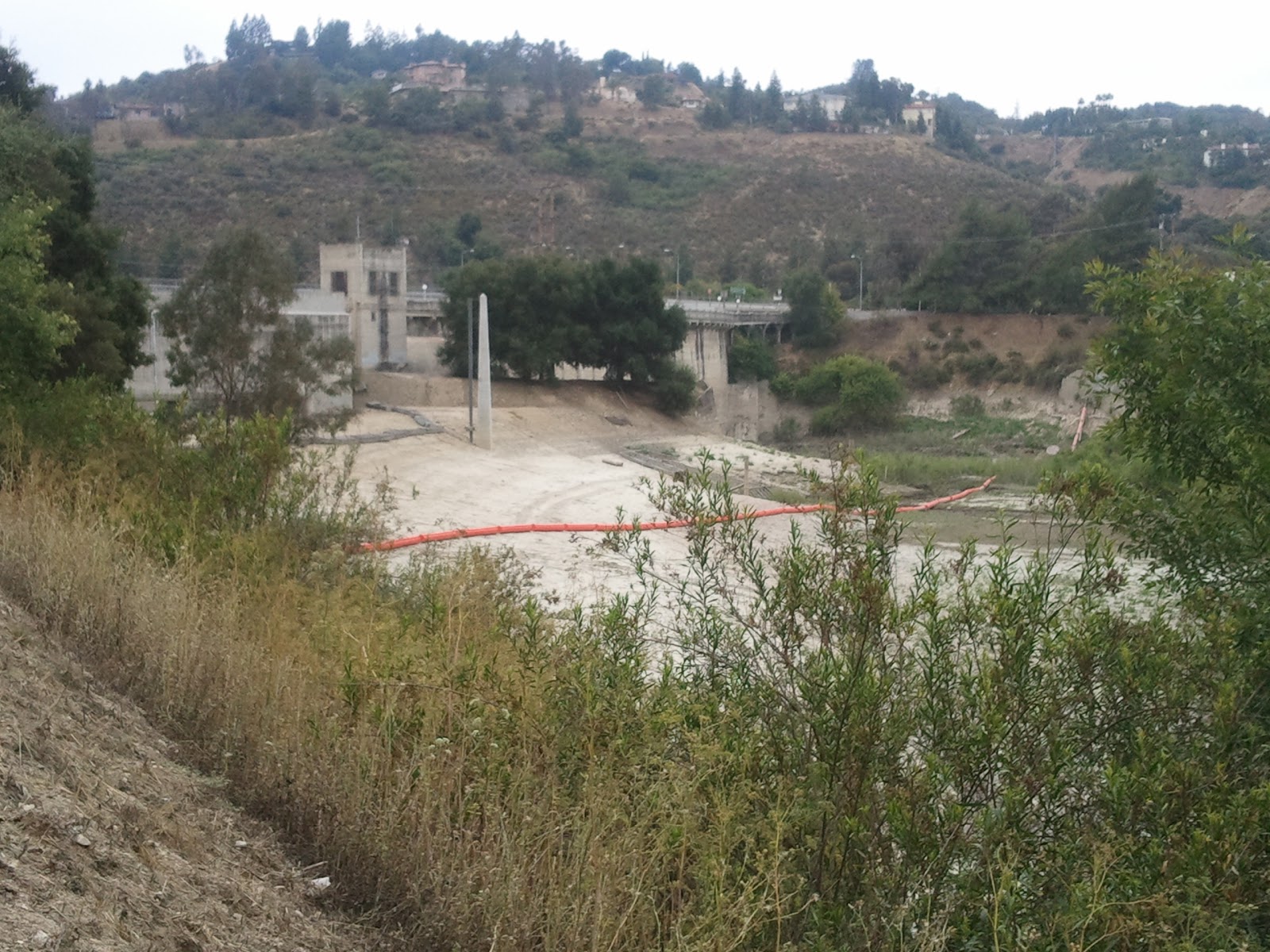
.The 2009 Station Fire wildfire burns almost 70% of the upper Arroyo Seco watershed, depositing over 1,000,000 cubic yards of sediment into the Hahamongna Basin, much of which collects behind Devil's Date Dam
.LA County plans to remove all sediment in the Basin under 'emergency' maintenance procedures which do not require an Environmental Impact Report
.The local environmental community protests and the LA County Board of Supervisors approves a resolution requiring a complete EIR be done before sediment removal occurs, with the exception that County Public Works can remove 25,000 cubic yards this summer directly behind the Dam because of emergency maintenance conditions.
.LA County Dept of Public Works finalizes its interim sediment measures and starts conducting community outreach meetings to review truck transportation routes to haul the sediment out of the Basin for relocation to Scholl Canyon.
.The interim sediment removal plan must be completed by October 15, 2011, when the annual rainy season traditionally begins.
Yet the controversy seems to go on....
Why?
First, while LA County has put together a generally sound interim sediment plan, it has failed in its ability to properly communicate this plan to the public. Case in point: last Thursday night's outreach meeting at La Canada High School to discuss the 'truck haul' plans. What didn't go wrong? The powerpoint did not work. There were no handouts. A new alternative #4 to keep the sediment in the Basin was announced with little context as to why this option was now being offered. Presenters seemed to be at a loss to directly answer many questions posed by the attendees.
But the enviro community and residents are not blameless here, either. Numerous bloggers, local residents and environmental organizations continue to disseminate skewed information and promote 20th Century style scare tactics online and in whisper campaigns to rally their troops towards either stopping this sediment removal or warning of 'dire' consequences if it occurs. They aren't offering any proactive alternative solutions, either.
So let's look at the facts relevant to public safety. (All these documents are online and available to the public at the dpw.lacounty.gov site.)
If you click on the header to this blog, you will be taken to the LA County Staff Report to the Board of Supervisors which accurately discusses the issues. Then take a look at the powerpoint for the interim removal plan here:
tp://dpw.lacounty.gov/wrd/removal/DevilGate/CVAC_Interim_Measures_20110525.pdf
When we cut to the chase these facts remain:
1. The sediment directly behind Devil's Gate Dam has reached a level of 1,009 feet
2. This sediment is blocking at least two sluice gates, which are responsible for releasing water through the flood gates.
3. This sediment is also close to clogging the outlet valves at the top of these sluice gates.
4. This sediment, if not removed this summer, will likely clog outlet valves, including tunnel water outlets after the next rainy season.
Clogged sluice gates and tunnel water outlets mean that the Watermaster will be unable to discharge water through the dam.
Here's the unknown: how much precipitation the Arroyo Seco watershed will get this rainy season. It's especially difficult to predict because we are now experiencing chaotic weather patterns, witnessed by Mississippi River flooding, deadly Southern tornados and a West Texas drought and fire storm. As one local example, the experts at NOAA predicted a 'dry' La Nina last year and we got instead one of the wettest seasons in recent years. Should we have another wet rainy season, even more sediment will flow into the Hahamongna, resting behind the Dam.
Based upon these facts, can we really afford to take the risk of doing nothing about sediment removal behind the Dam this summer?
Let's review the sediment removal 'haul out' options (see the map on the powerpoint link). Unfortunately, projects of this scope and type always have short-term negative impacts on the local community. Truck traffic with attendant noise over the 4 week haul out time period will inevitably be a short term nuisance to affected residents and local commuters (JPL, La Canada High students, park users).
It's totally understandable that residents are concerned about the County's initial preference to use Alternative Route #1 down Windsor Boulevard. For the County, it is the fastest route out and will require the minimal infrastructure work to get this job done. For years, these residents have dealt with the noise and congestion of heavy trucking on this roadway due to the La Vina development, the City of Pasadena's water treatment plant construction, and regular deliveries to JPL.
That's why the recent agreement between the County and the City of Pasadena Water and Power which makes the availability of Johnson Field, located on the northeast side within the Hahagmongna Basin, as a sediment removal holding site welcome news. Use of Johnson Field will decrease truck hauling by 80% since only 20% of the organic materials will have to be hauled out of the Basin itself. The remainder will be hauled to and 'stored' on Johnson Field, which has not been used as a playing field for years.
The local in-basin haul to Johnson Field will also support the short timeline the County has to move this buildup because sediment needs to be 'dried out' first before it can be relocated due of its heavy weight when saturated by water.
Ultimately, there is no solution that will make everyone 100% happy, so it's important to keep our focus on the big picture. The Hahamongna is first and foremost a flood control basin and water conservation reservoir. We continue to face dire long-term local water reliability challenges. Unfortunately, this past winter's extremely wet season has blunted our awareness that we still need to conserve water. All three of Southern California's imported water sources remain in distress. Beyond immediate public safety concerns, sediment buildup behind Devil's Gate Dam significantly reduces the amount of groundwater that can be stored for local recharge in the Hahamongna Basin.
All rivers carry both water and sediment. There is ample opportunity for all of us to work towards a fully integrated long-term strategy for sediment removal as part of the full sediment removal plan and EIR for the Hahamongna. In the meantime, let's support the interim sediment removal measures, including Johnson field Alternative #4 transport, so that our focus can be on proactive solutions for the future rather than on emergency disaster cleanup and a real risk to public safety.


