Showing posts with label Rose Bowl. Show all posts

Friday, August 5, 2011

Riding Along the Arroyo Seco on the Back of a Horse

Once in awhile, serendipity creates a great adventure.

Such was the case last week when I spotted a friend bathing one of his horses on a weekday afternoon. Surprisingly, we both had finished with work early that day and before I knew it, he said, "Let's go riding!"

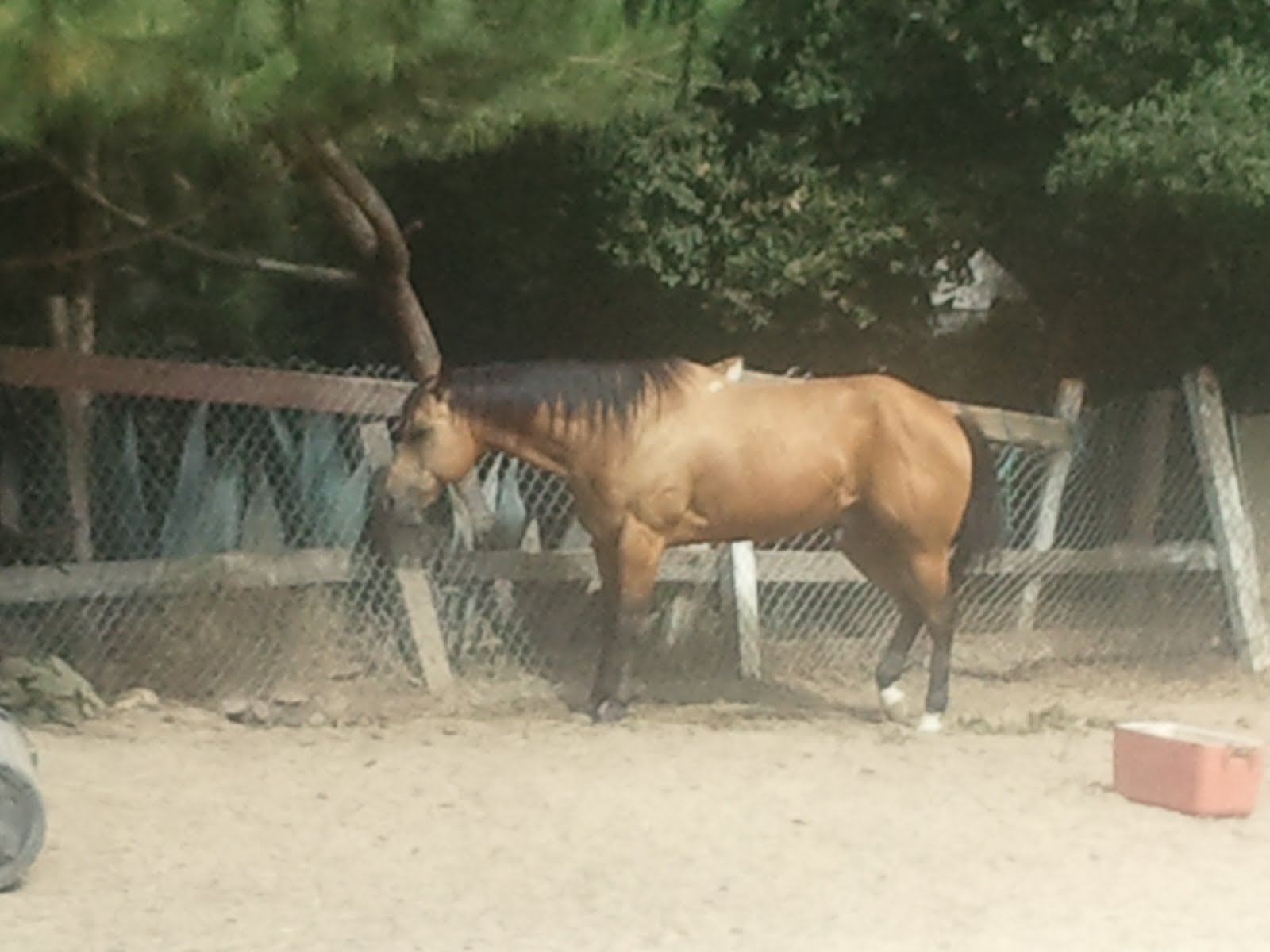
For a horse lover like me, I jump at the chance to ride whenever I can, so we took off on our trusted steeds, him on Maya, me on Lobo (seen here) for what I thought would be an hour ride from the Altadena Crest Trail to the Loma Alta Equestrian Arena.

But you can't stop horse people when they are having a great ride on a beautiful summer's afternoon. Before I knew it, I was agreeing to ride all the way down to the Rose Bowl in Pasadena (a four hour round trip ride, I might add)!

And what a great ride it was! Entering the Hahamongna Basin eastside trail from Altadena Drive, we enjoyed a slow quiet ride through one of Pasadena's great urban nature corridors. The birds were singing, the air was fresh from a slight breeze and the Arroyo Seco was still full of water, unusual this late in the summer season. Except for the passing of an occasional walker and photographer, we had the trail all to ourselves.

Soon we were travelling through the Devil's Gate Bridge tunnel down the trail to the Central Arroyo. I especially loved riding this section - so natural and quiet with the unchannelized Arroyo Seco stream to our right, gurgling along.

Civilization in the form of Brookside golfers and Rose Bowl Loop bicyclists and joggers soon appeared as we turned onto Washington Blvd to Parkview towards the westside Arroyo Seco trail heading back northward.

This was my first time on the Central Arroyo Seco westside trail and what a delight! Most of this trail is shadowed by old age oak trees on one side with a bucolic view of Brookside Golf Course on the other. My unflappable horse, who calmly walked down city streets, past bicyclists, cars, and joggers, stopped and perked up his ears each time a golfer teed off and the 'whiff' sound filled the air.

I really loved being on the westside trail which brought us right next to the Arroyo Seco stream north of the golf course. In fact, we had to cross the stream, about ankle deep, to reconnect to the trail back into the Hahamongna and northward home. What fun!

Sir Winston Churchill once said that 'the outside of a horse is good for the inside of a man' (or woman!) and this adage was no more true than while on this ride along the Arroyo Seco.  It's incredible that it's possible to ride (or walk!) streamside in an urbanized area of Southern California....yet feel totally in nature.

I can't wait to continue my horseback riding adventures along the Arroyo Seco and look forward to future trips both northward into the Angeles National Forest and southward into the Lower Arroyo Seco and South Pasadena Nature Parks.

Monday, May 9, 2011

The Real Hahamongna Dilemma

At first glance, you may think this photo is the Arroyo Seco flowing through the Hahamongna.

But this is actually the Arroyo Seco flowing south of Devil's Gate Dam just above Brookside Golf Course and look at that sediment!

One of the saddest legacies of the devastating 2009 Station Fire is that the complete burn of the upper Arroyo Seco Watershed created massive sediment debris flows into the central and lower reaches.

While lots of public outcry is being played out in the media about LA County's plan to remove sediment in the Hahamonga and the impact of that operation on habitat in that basin, no one is talking about what will happen downstream if the dam fails due to sediment buildup overload.

Already, heavy sediment flows into the Central Arroyo Seco have damaged most river restoration enhancements completed in 2008, including complete mortality for the small, yet growing school of native Arroyo Chub fish that was successfully reintroduced. In fact, the backwater pool under the Colorado Street Bridge is so full of sediment, you wouldn't even know that a pool once existed there.

In addition to the habitat damage, the sediment buildup both above and below the Rose Bowl complex is such that, without sediment removal behind the Dam, this popular recreation area could experience a flood or near flood event within the next year or so if rainy seasons replicate last year's deluge. Moreover, LA County's effort to relieve stress on Devil's Gate Dam from sediment buildup has included extra water releases into the Central Arroyo, contributing to the sediment buildup there.

This flooding potentiality was driven home last week during a tour by flood program representatives of the California Department of Water Resources who expressed shock (their actual word) at the level of sediment buildup behind the dam and its growing buildup in the Central Arroyo, especially as it 'backs up' into the channelized area just before the softbed section south of the Parking Lot I picnic area.

What would it mean to Pasadenans and their neighbors if the Brookside Golf Course and the Rose Bowl areas flooded?

First, it would mean no access to highly used recreational amenities, including the Rose Bowl Loop, which draw almost 3,000,0000 people to Brookside Park every year. Secondly, it would mean a major financial and logistics emergency preparedness cleanup effort by the City of Pasadena and LA County which would cost in the tens of thousands of dollars at a time of stressed public agency funding. Finally, it would mean a direct loss of over $4,000,000 in annual revenues that the City of Pasadena relies upon to fund its operating budget.

Here are some sobering facts:

.the 1938 Arroyo Seco flood damaged 85% of Brookside Golf Course and filled the Rose Bowl to its first tier level of seating until the river changed course and spared further damage to the stadium
.the Arroyo Seco Concrete Channel is nearing the end of its useful life
.the lack of federal funding match to complete the US Army Corps of Engineers Arroyo Seco Feasibility Study, first approved in 2003, hampers federal financial support for channel realignment or relocation in the Central Arroyo
.there is a high risk of little federal support in the event of a flood event in Brookside Park because, in part, the Federal Emergency Management Agency (FEMA) never created a flood inundation map for the area after the Arroyo Seco was channelized
.the Arroyo Seco Concrete Channel has never really been challenged with the type of heavy water/sediment flow now possible, so it is unknown whether it will actually 'hold' should a catastrophic spring flood event like the current Ohio and Mississippi River flooding test its strength

Let's hope that the newly created Sediment Removal Advisory Commitee will work with LA County Flood Control Management District leadership, state agencies, and federal officials to find sustainable solutions to Arroyo Seco sediment buildup that takes into account the larger context of impact that goes beyond the mere perimeter of the Hahamongna Basin.

Saturday, January 1, 2011

Here's to a Happy New Year Along the Arroyo Seco

As we enter a new year and a new decade, I want to take a moment to focus on why I write this blog: to teach us all how to love, respect and restore our fresh river waterways.

Since the 97th Rose Bowl Game is being played today, it seems appropriate to spend a moment talking about the historic Arroyo Seco whose waters flow through Brookside Golf Course and just to the west of the 'granddaddy of them all' football stadium.  Pictures speak louder than words, so here's the video I produced and directed which showcases the important urban river restoration work that the City of Pasadena and Arroyo Seco Foundation project team completed along the Arroyo Seco in 2008. The next time you visit the Rose Bowl/Brookside Park, take a walk along the Arroyo just south of Parking Lot I and discover nature in the city.

Our work is never done, so please make one of your New Year's Resolutions the commitment to come join us for the 22nd Great River Cleanup on Saturday, April 30, 2011. Details here: http://folar.org/?page_id=5

Enjoy...and may all your dreams come true!


Enhanced by Zemanta

Monday, July 19, 2010

How a River Makes You Free


I imagine that since time immortal curious people who have come upon a riverway have asked, 'I wonder where it goes.'  This certainly has been a question that has led to lot of my personal explorations.

Americans love to talk about freedom, and nothing is freer than a natural river course flowing through the countryside or urban landscape. It's also usually free (no cost) to wander along its river banks while observing nature, creating art (music, plein air painting, photography, video), recreating (bicycling, golfing, horseback riding), meditating (yoga, tai chi) or picnicking with friends.

Rivers teach us so much about the flow of life, if we stop by their shores and contemplate enough about the ecosystem of which they are the centerpiece. Lessons like the power of gravity, the tremendous change achieved over a long period of time (tree growth, worn rock, eggs to tadpoles to frogs), and the 'moods' of water (angry, raging flows ~ bubbling brooks ~ languid glassy weirs).

In fact, much of America was 'discovered' as explorers followed riverways to see where they led. The Lewis & Clark Expedition to the Northwest Passage is a great example.

In modern times, though, we've put down roots and harnessed the power of the rivers for our drinking water, transportation corridor, and sanitation needs.

Often lost in our attempts to be 'civilized' is giving ourselves permission to be free. Because virtually all communities are established next to rivers, accessing river trails, bridges, and river parks is usually pretty easy.

And that is one of the great joys of the Arroyo Seco in Southern California.  For much of its 26+ mile journey from the Angeles National Forest to its confluence with the Los Angeles River, the Arroyo Seco is free and accessible by foot, horseback or bicycle.

Its northernmost shores are natural riparian habitat, with plenty of shade trees, song birds, and small wildlife, creating a bucolic idyll in the midst of the City of Pasadena and surrounding areas.

Its central shores focus on recreation with the Rose Bowl, soccer fields, and three golf courses providing outdoor fun within view of the river's edge, often overlooked because of the concrete channel in which it now flows. Yes, The Arroyo Seco, which flows through Brookside Golf Course, is even a water hazard and intrepid 'fishermen' are often seen retrieving golf balls from its stream.

Along the lower channelized Arroyo Seco in Los Angeles, there's the chance to walk/bicycle right next to the streambed along the approxinmately 2 mile Arroyo Seco Bikeway that connects York Blvd. to Avenue 43 via the river. (See my July 12, 2009 post on the Bikeway)

Yes, the river truly opens us to our free-est selves when we meander its shores. Yet none of us will truly be free until all our rivers flow free as well.  And that's why I work so hard to restore our urban riverways to their natural states.

Have you visited your river recently?

Wednesday, January 6, 2010

Arroyo Seco's Rose Bowl Stadium: The Granddaddy of Them All


With the 2010 Rose Bowl Game now history and the BCS National Championship game just hours away, it seems fitting to spend a few minutes lauding the amazing Rose Bowl Stadium in Pasadena's Brookside Park, adjacent to the Arroyo Seco.

As an attendee at this year's Rose Bowl Game, I was reminded of the amazing sightlines from virtually any seat in the stadium (except the first 10 rows which are disappearing as part of a major stadium upgrade over the next few years).

While the Rose Bowl Operating Company, under the able leadership of Darryl Dunn, keeps a multitude of sports and entertainment events running smoothly year round, it is the stadium itself that fascinates me.

Most people don't realize that the Rose Bowl is both owned and operated by the City of Pasadena, a rarity in today's modern sports world. According to the Tournament of Roses history, Pasadena purchsed the 10 acre Arroyo Seco site where the stadium currents sits in 1897. Building of the stadium commenced in 1921 and the stadium, designed to be the 'official' home of the Rose Bowl Game, was dedicated on January 1, 1923.

Do you know which teams played in the first football game in the stadium? It was the University of California Bears versus the University of Southern California Trojans on October 22, 1922, the first of many north-south California college games.

Here are some more fun facts, courtesy of the Tournament of Roses organization:

The official seating capacity is 92,542.

The stadium is a National Historic Landmark and its design was based on the Yale Bowl in New Haven, Connecticut.

It sits at an elevation of 825 feet above sea level.

Its playing surface is natural turf comprised Bullseye Bermuda grass with rye, cut to 1/2 to 5/8 inch on game day.

There are 357 Musco light fixtures of high intensity, metal lark halide.

The stadium has an elliptical shape with a north-south configuration.

Legendary Architect Myron Hunt designed the stadium, which was built at a cost of $272,198.

Official Address: 1001 Rose Bowl Drive, Pasadena, California 91103

You don't have to be a sports fan to love the Rose Bowl. It's worth a trip to Pasadena to just experience this magnificent work of living history. Be sure to wear your walking shoes so you can enjoy all that Brookside Park has to offer, including the public Brookside Golf Course and bucolic walking and equestrian trails along the beautiful Arroyo Seco stream.