Once in awhile, serendipity creates a great adventure.
Such was the case last week when I spotted a friend bathing one of his horses on a weekday afternoon. Surprisingly, we both had finished with work early that day and before I knew it, he said, "Let's go riding!"
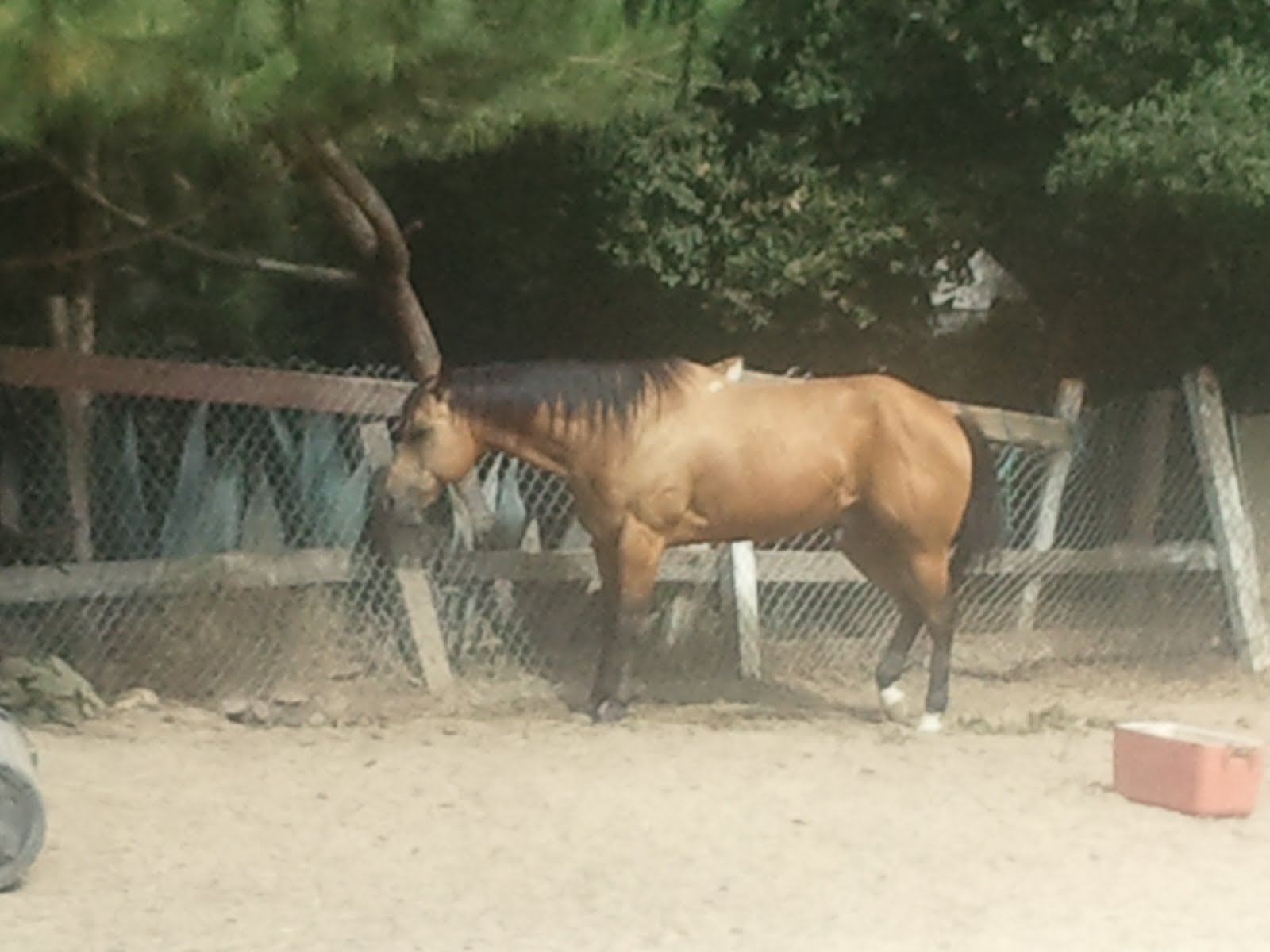
For a horse lover like me, I jump at the chance to ride whenever I can, so we took off on our trusted steeds, him on Maya, me on Lobo (seen here) for what I thought would be an hour ride from the Altadena Crest Trail to the Loma Alta Equestrian Arena.
But you can't stop horse people when they are having a great ride on a beautiful summer's afternoon. Before I knew it, I was agreeing to ride all the way down to the Rose Bowl in Pasadena (a four hour round trip ride, I might add)!
And what a great ride it was! Entering the Hahamongna Basin eastside trail from Altadena Drive, we enjoyed a slow quiet ride through one of Pasadena's great urban nature corridors. The birds were singing, the air was fresh from a slight breeze and the Arroyo Seco was still full of water, unusual this late in the summer season. Except for the passing of an occasional walker and photographer, we had the trail all to ourselves.
Soon we were travelling through the Devil's Gate Bridge tunnel down the trail to the Central Arroyo. I especially loved riding this section - so natural and quiet with the unchannelized Arroyo Seco stream to our right, gurgling along.
Civilization in the form of Brookside golfers and Rose Bowl Loop bicyclists and joggers soon appeared as we turned onto Washington Blvd to Parkview towards the westside Arroyo Seco trail heading back northward.
This was my first time on the Central Arroyo Seco westside trail and what a delight! Most of this trail is shadowed by old age oak trees on one side with a bucolic view of Brookside Golf Course on the other. My unflappable horse, who calmly walked down city streets, past bicyclists, cars, and joggers, stopped and perked up his ears each time a golfer teed off and the 'whiff' sound filled the air.
I really loved being on the westside trail which brought us right next to the Arroyo Seco stream north of the golf course. In fact, we had to cross the stream, about ankle deep, to reconnect to the trail back into the Hahamongna and northward home. What fun!
Sir Winston Churchill once said that 'the outside of a horse is good for the inside of a man' (or woman!) and this adage was no more true than while on this ride along the Arroyo Seco. It's incredible that it's possible to ride (or walk!) streamside in an urbanized area of Southern California....yet feel totally in nature.
I can't wait to continue my horseback riding adventures along the Arroyo Seco and look forward to future trips both northward into the Angeles National Forest and southward into the Lower Arroyo Seco and South Pasadena Nature Parks.
Musings of natural and human life along the world's urban waterways, with a focus on the Arroyo Seco and Los Angeles Rivers in Southern California.
Showing posts with label Hahamongna Watershed Park. Show all posts
Friday, August 5, 2011
Monday, August 1, 2011
The Pasadena Open Space & Conservation Element Update Points to a Sustainable Future
While local activists debate sediment removal in the Hahamongna at tonight's City Council meeting, another meeting will be taking place with a Pasadena City-appointed committee of citizens who have quietly been working for the past year and a half on the updating of the Open Space & Conservation Element to the City of Pasadena General Plan.
Under current State law, all California cities must periodically update their general plans, addressing such elements as housing, transportation, and health. The current committee has been working diligently with City staff and community stakeholders to both update the current Open Space & Conservation Element and integrate these general plan elements with the Green Space Element approved by the City in 2007 as well as the City's Green City Action Plan for sustainability (air quality, water quality/conservation and energy/greenhouse gas reductions).
After months of fact-finding, deliberation, community outreach meetings, walkabouts, and review of numerous plans and studies, the draft document for the Open Space & Conservation Element has been completed and will now be circulated to other City Commissions, including the Environmental Advisory Commission and the Recreation and Parks Commission, for review before reaching the Pasadena City Council for final approval.
The 63 page document, which can be accessed by clicking this blog's headline, provides a comprehensive overview of current City natural elements, conservation partners, sustainability issues, and urban nature needs within a framework to guide the City for future open space acquisitions and current open space stewardship. It was particularly gratifying to see in this report the extensive attention placed on the role that open space and conservation plays relative to water conservation and sustainable building practices.
The Open Space & Conservation Element Committee meets tonight at 6:45pm in the Grand Conference Room in the Basement of Pasadena City Hall. The meeting is open to the public and will be a fascinating update on a visionary future for Pasadena's urban nature culture with an eye towards an integrated approach to sustainability.
Friday, March 4, 2011
Walk About the Hahamongna This Saturday
It's been quite a week for Pasadena's Hahamongna Watershed Park. Long a nature getaway for hikers, walkers, dog lovers, equestrians and birders far and wide, Hahamongna has recently been at the center of controversy relative to Los Angeles County's plan to remove 1.6 million cubic feet of sediment from behind Devil's Gate Dam at the south end of the natureland, which would cause irreparable damage to sensitive willow habitat.
Earlier this week, Los Angeles County Supervisor Mike Antonovich sponsored a motion, approved by the Board of Supervisors, to conduct a full environmental impact report on the sediment management program at Devil's Gate Dam and Hahamongna in the Arroyo Seco. The motion included a provision that Public Works staff report back to the Supervisors within 30 days on short-term measures that might be needed to ensure the functioning and safety of the Devil's Gate Dam.
Now you can personally see what the fuss is all about.
Tomorrow, March 5th, The Save Hahamongna Coalition and the Arroyo Seco Foundation are hosting a FREE 3 hour 'walkabout' of the Hahamongna Watershed Park where visitors can stop at a number of 'learning stations' and discover more about the habitat, wildlife, birds and water resources in this unique flood basin at the foothills of the San Gabriel Mountains.
You will also learn about new threats to the natural character of Hahamongna and what you can do to help protect this precious spot. Tours will leave each half hour from 9:00 am to 10:30 am, so reserve your place by going to http://www.savehahamongna.org/walkaboutrsvp.htm.
Tuesday, December 21, 2010
Lake Hahamongna Appears in Pasadena
If you were a casual observer, you might think that the above photo features a bucolic lake in the Midwest or South.
The recent Los Angeles area rainstorms have dropped about 9 inches of rain in this foothills area, as of noon on December 21st, with another major storm entering the region tonight. Even though the flow of the Arroyo Seco is clearer than after last year's rains, this shot just above the Dam shows significant sediment build-up, possibly a result of last year's Station Fire.
By my estimation, Lake Hahamongna appears to be about two to four feet deep. The red buoys in the photos are to hold back debris flows from the Upper Arroyo Seco Canyon. If you look closely, you'll see branch and log debris in addition to the sediment above the buoys.
This beautiful lake is reminiscent of the Arroyo Seco and the Los Angeles River in days of yore when both riverways ran free - a place where earth, water, vegetation, and animals lived in harmony among our Native Americans fishing for trout while floating along their waters in canoes. And as we all know, the Arroyo Seco is one of the main tributaries of the Los Angeles River, where fish movement once reached over 50 miles from the mountains to the sea.
Does this look like the place where soccer fields should be?
When the camera pulls back, though, it's evident that Lake Hahamongna is right here in Pasadena just above Devil's Gate Dam, where the Arroyo Seco flows through the Hahaongna Watershed Park, one of the last intact allevial fans in urbanized Southern California. (That's NASA/Jet Propulsion Laboratory in the far distance.)
By my estimation, Lake Hahamongna appears to be about two to four feet deep. The red buoys in the photos are to hold back debris flows from the Upper Arroyo Seco Canyon. If you look closely, you'll see branch and log debris in addition to the sediment above the buoys.
This beautiful lake is reminiscent of the Arroyo Seco and the Los Angeles River in days of yore when both riverways ran free - a place where earth, water, vegetation, and animals lived in harmony among our Native Americans fishing for trout while floating along their waters in canoes. And as we all know, the Arroyo Seco is one of the main tributaries of the Los Angeles River, where fish movement once reached over 50 miles from the mountains to the sea.
Does this look like the place where soccer fields should be?
Tuesday, December 7, 2010
Hahamongna Bloggers to be Honored with Arroyo Verde Award
Who knew that the small effort of 23 Pasadena area bloggers who collectively spoke out on our blogs last July about the City of Pasadena's plan to put soccer fields in the Hahamongna Watershed Park would have such an impact?
This and all 2010 Arroyo Verde Awards will be presented on Thursday, December 8th, in a celebration from 6:30pm to 8:30pm at Kidspace Museum, Brookside Park, Pasadena.
The event is free and open to the public.
Special thanks to Petrea Burchard for organizing this blogging effort!
To read my Hahamongna Blog on the soccer field controversy, scroll down to the July 2010 archive and click, An Open Letter to the Pasadena City Council on the Hahamongna Athletic Fields.
In recognition of the outreach, debate, and conversations generated from all our posts, the Arroyo Seco Foundation is honoring the "Hahamongna Bloggers" with the 2010 Best Advocacy Arroyo Verde Award.
This and all 2010 Arroyo Verde Awards will be presented on Thursday, December 8th, in a celebration from 6:30pm to 8:30pm at Kidspace Museum, Brookside Park, Pasadena.
The event is free and open to the public.
Special thanks to Petrea Burchard for organizing this blogging effort!
To read my Hahamongna Blog on the soccer field controversy, scroll down to the July 2010 archive and click, An Open Letter to the Pasadena City Council on the Hahamongna Athletic Fields.
Friday, July 16, 2010
A Tale of Two Rivers ~ A Tale of Two Cities
It was a week of big decisions for the Los Angeles and Arroyo Seco Rivers.
First, the City of Los Angeles, which has encased its beautiful Los Angeles River in concrete for decades, received word from US EPA that the River and its tributaries have been declared 'traditionally navigable' waterways. This means both federal funds for restoration and revitalization under the Clean Water Act, as well as regulatory support to improving ecosystem and drinking water quality.
In contrast, the City of Pasadena, which has prided itself on its 'Arroyo Culture' and 'Arroyo Seco Master Plan,' saw its City Council refuse to reconsider its 7-year-old decision to construct new athletic fields in the sensitive Hahamongna riparian basin, groundwater source of drinking water to hundreds of thousands in the region and home to one of Southern California's most sensitive urban interface ecosystems. (In fairness, the Council did reject one of two proposed 'soccer' fields which would be located in a part of the Basin currently inundated as a small lake with ducks swimming in it.)
The irony? While Los Angeles continues to move forward in removing concrete and debris from the Los Angeles River, Pasadena moves forward with building an artificial turf athletic field and parking lot within its natural Arroyo Seco riverine corridor.
These actions beg the question: which city is truly more committed to natural resource sustainability and local water supply reliability?
Tuesday, July 6, 2010
An Open Letter to the Pasadena City Council on Hahamongna Athletic Fields
Dear Mr. Mayor and City Council Members:
Please support the Hahamongna Advisory Committee's request to reconsider current city plans to build an athletic field and parking lot in the Hahamonga Watershed Park.
As a resident and constituent, I am voicing support for this reconsideration in light of numerous changed conditions since the Council's initial approval of plans in 2003.
These include:
1. environmental, climate, and political factors that have negatively affected the security of our local water supply and water quality.
Pasadena's current heavy reliance on imported water at a time of protracted water shortage creates tremendous vulnerability for our City's ability to provide reliable domestic water for local businesses and residents. The recent Station Fire, which devastated the upper Arroyo Seco watershed, has caused increased run-off and groundwater toxins into this already vulnerable water basin. A healthy natural habitat is essential to supporting a clean local water supply, and the building of any new infrastructure, including those planned, will destroy key elements of one of Southern California's last remaining allevial canyons where five habitat zones intersect. The City's inability to provide for local long-term water storage, treatment, and distribution will have a wide ranging effect, including negative consequences for the City's very important tourism economic engine.
2. mobility barriers that make it difficult to reach the proposed fields.
The Hahamongna Watershed Park currently has access from a two-lane street which is already experiencing heavy traffic congestion. Further, the Park itself has narrow lanes for vehicular traffic. Because of the park's location and current natural/passive recreation atmosphere, it is not easily accessible by bicycle, walking, or bus/shuttle transit. This Council is already on record stating that there will be no new roads in the Hahamongna without direct Council approval. This means that in addition to the cost of building parking lots in the Hahamongna, which will both disturb rare and sensitive natural habitat as well as prevent vital groundwater percolation, it is highly likely that 'overflow' of cars and vans will end up creating their own 'roads' and parking on non-parking surfaces, as I have witnessed at other sports recreation complexes. As a soccer mom, I can personally attest to the amount of equipment, water, first aid, chairs, umbrellas and other 'entourage' materials that regularly are part of organized youth athletic activities. I fear that the end result of any field/parking lot construction will overburden already taxed mobility access and available surface parking.
3. lack of consistency between the Hahamongna Master Plan and Pasadena's Green City Action Plan.
Since City Council passed the Green City Action Plan in 2006, almost three years after the Hahamongna Master Plan was approved, there has been no formal effort to reconcile the Green City elements with the Hahamongna Plan. Given Pasadena's leadership within the US Conference of Mayors Climate Protection Agreement and the 2006 United Nations Green Cities Declaration and Urban Environmental Accords, any final plans for the Hahamongna, including but not limited to athletic fields, would be flawed without coordination and reconcilitation of differences between these two important initiatives of the City, which prides itself as a sustainable community.
Your vote on July 12th to support reconsideration of the current city plan for athletic field construction in the Hahamongna will give our community and city staff a full opportunity to review and weigh the merits of current plans in light of the critical factors set forth above.
Thank you very much for your serious reflection on this request for reconsideration of plans for Hahamongna athletic fields. I look forward to your affirmative vote to support the reconsideration process.
Sincerely,
Meredith McKenzie
The Arroyo Lover
Monday, November 9, 2009
California Water Week in Review
The first week of November 2009 was quite a week for water in California.
First, the Chino Basin Water District decided to postpone its massive surplus water auction, which had gained international attention and a projected auction bidding of up to $1000 per acre foot! http://bit.ly/3HC9XQ
More importantly, the California State Assembly and Senate passed a series of bills to create an $11 billion bond package for voters to consider in November 2010 to revamp the state's aging and overstrained water delivery system.
The new water bill's approval came just as UCLA Law's Emmett Center on Climate Change and the Environment was holding its symposium, "Adapting to a Parched Future: Cities, Development, and the War for Water."
While the initial focus of this seminar was on water/development issues, the newly approved water legislation quickly took center stage among the esteemed panel, which included Ellen Hanak, Director of Research and Senior Fellow, Public Policy Institute of California; Peter Hsiao, Head of the Los Angeles Land Use and Environmental Law Group, Morrison & Foerster LLP; Brandon Goshi from the Metropolitan Water District of Southern California - ably pitch-hitting for CEO Jeff Kightlinger; and Mark Gold, President, Heal the Bay. Cara Horowitz, Sabin Family Fdn Executive Director, Emmett Center on Climate Change and the Environment, served as moderator.
Ellen Hanak presented the opening overview of California's current water situation, which is well-known to those of us who follow this issue. She was followed by comments from Brandon Goshi on the importance of water conveyance during normal seasons to replenish the massive storage instructures that MWD has built in Southern California, notably Diamond Valley Lake. He added that MWD supported the water bill package because it serves the dual goal of ecosystem restoration and reliable water supply delivery.
Peter Hsiao veered the topic back towards water solutions through a thoughtful presentation on how new solar energy panel transmission in the Owens Valley can generate both important non-hydroelectric energy to Southern California as well as mitigate the tremendous windstorms and environmental damage created by the overdrafting of the Owens River for so many years.
Mark Gold explained why Heal the Bay opposed the legislative water package, noting that it tended to nibble around the edges of the problem, rather than promise true water reform. He also stated his misgivings about whether the $11 billion package would pass voter muster next November, adding that even if it did pass, the current inability of the State of California to sell bonds for already enacted Proposition 84, (a water bond act passed two years ago), did not bode well for future bond sales of any type. Asked if HTB would oppose the bond ballot measure itself, Mark stated that it was too early to tell, since that would be a decision of his board of directors. He opined that HTB might stay neutral on the issue.
On a positive note, Mark did state that he felt that several local efforts in Los Angeles and Ventura Counties were bearing fruit in developing with groundwater cleanup and low impact development.
A spirited question and answer period followed, with panelists answering questions from whether the bond will pass (Ellen Hanak predicted yes, since it won't raise taxes and there's something for everyone in it, like a Christmas tree) to the absence of an agriculture representative on the panel.
It's important to note that the approved bond legislation does not include the construction of a new statewide water conveyance (a la the Peripheral Canal), along insiders tell me that the major water users are seeking ways they can fund it in partnership with federal stimulus money.
So what does the juxtaposition of a massive multi-billion dollar water bond with the potential sale to private parties of over 240,000 acre feet of privately managed water mean?
My crystal ball indicates that we will continue to see the powerful disconnect between water politics and reality for at least the next 24 months. Even in a best case scenario for the water bond, its passage next November means that those bonds won't even be floated until spring of 2011 and funding won't flow until fall of that year at the earliest.
How, then, will this affect the small, average water user in the meantime? I don't think it's a stretch to predict continued water rationing with greater fines, more water pipe bursts, and continued ecosystem damage in the delta, coupled with sporadic environmental damage throughout the state in such areas as the Station Fire burn area, where massive water run-off in the Arroyo Seco watershed and possible mudslides, regardless of the amount of rainfall, is inevitable.
Tuesday, June 30, 2009
In Search of the Engelmann Oak

Over the past few days, I've had the joy of finding a few Engelmann Oak trees, which only exist in a narrow band that stretches along the foothills of Southern California from Pasadena down through Orange and San Diego County into Baja California. They need to be twenty miles or more away from the ocean at an elevation of 500-4000 feet.
On Friday evening, one of my friends and I enjoyed the monthly 'Night Walk' at Descanso Gardens in La Canada, where I not only saw an Engelmann Oak but learned that Descanso is one of only two garden 'museums' (botanical gardens where every plant has been catalogued) in Southern California ~ the other being the Los Angeles Zoo. When I asked if there were any Engelmanns at Descanso, our wonderful volunteer guide turned to me and said, "How do you know about the Engelmann Oak?"
How could I not know about the Engelmann (quercus engelmannii)? As Arroyo Seco advocate Tim Brick notes, the majesty of the Engelmann can take your breath away. Their large twisted spreading limbs generally form a sparse crown. Their gray/green leaves are more elliptical or oval than the Coast Live Oaks, and their acorns more stubby. They often reside near Coast Live Oaks and Sycamores. Engelmann Oaks are probably the most imperiled of all tree oaks and are one of the most endangered natural plant communities in California.
Then, yesterday, I had the thrill of joining Roger Klemm and the Tom Sawyer campers as they planted Englemann Oak and Live Coast Oak seedlings in the Hahamongna Watershed Park, one of the Arroyo Seco's most spectacular nature parks with a terrific old-growth grove of native oak trees.
The planting ceremony was especially sweet because the young campers not only learned how to properly plant, water, and protect these young seedlings with chicken wire casing, but they also 'named' each tree they planted. The first seedling planted, a Coastal Live Oak, was named 'Michael Mayes' ~ commemorating the sudden deaths of Michael Jackson and Billy Mayes.
I'll always smile when I remember the students holding hands in a circle around their new planting, while chanting: 'Trees need people. People need trees. Welcome, Michael Mayes!'
Hopefully, in a few years, they will be able to return and point to 'their tree.'
While standing next to a magnificent adult Englemann Oak, I gazed upon a newly planted Englemann seedling and for a moment glimpsed at a future mighty oak.
Thursday, May 21, 2009
What's a Hahamongna?
The answer is none of the above. This bucolic nature park is less than 30 minutes from downtown Los Angeles and is home to one of the largest old age oak groves still intact in Southern California.
This parkland also graces the banks of the Arroyo Seco River. Where is it?
It's the Hahamongna Watershed Park in Pasadena, California.
Thanks to the hard work of lots of civic leaders, environmentalists, and community activists, the City of Pasadena created an Arroyo Seco Master Plan (http://bit.ly/qim06), which includes the four components of the Hahamonga Watershed Park Master Plan, the Central Arroyo Master Plan, the Lower Arroyo Master Plan, and the Design Guidelines for the Arroyo Seco.
In 2005, the City of Pasadena acquired a 30-acre adjacent parcel, known as the Hahamongna Annex, whose future uses are limited to open space and recreational use. Currently, the City is working on a plan to amend the Hahamongna Master Plan to integrate the Annex: http://bit.ly/4SRO4.
Whether you personally enjoy the Hahamongna or just want to learn more about how an environmental master plan is created and modified through public comment and advocacy, the Hahamongna annex is a fascinating study of the push-pull dynamics at work when a municipality is seeking to 'rehabilitate' a parcel within a long-used natural riparian parkland.
Subscribe to:
Posts (Atom)


