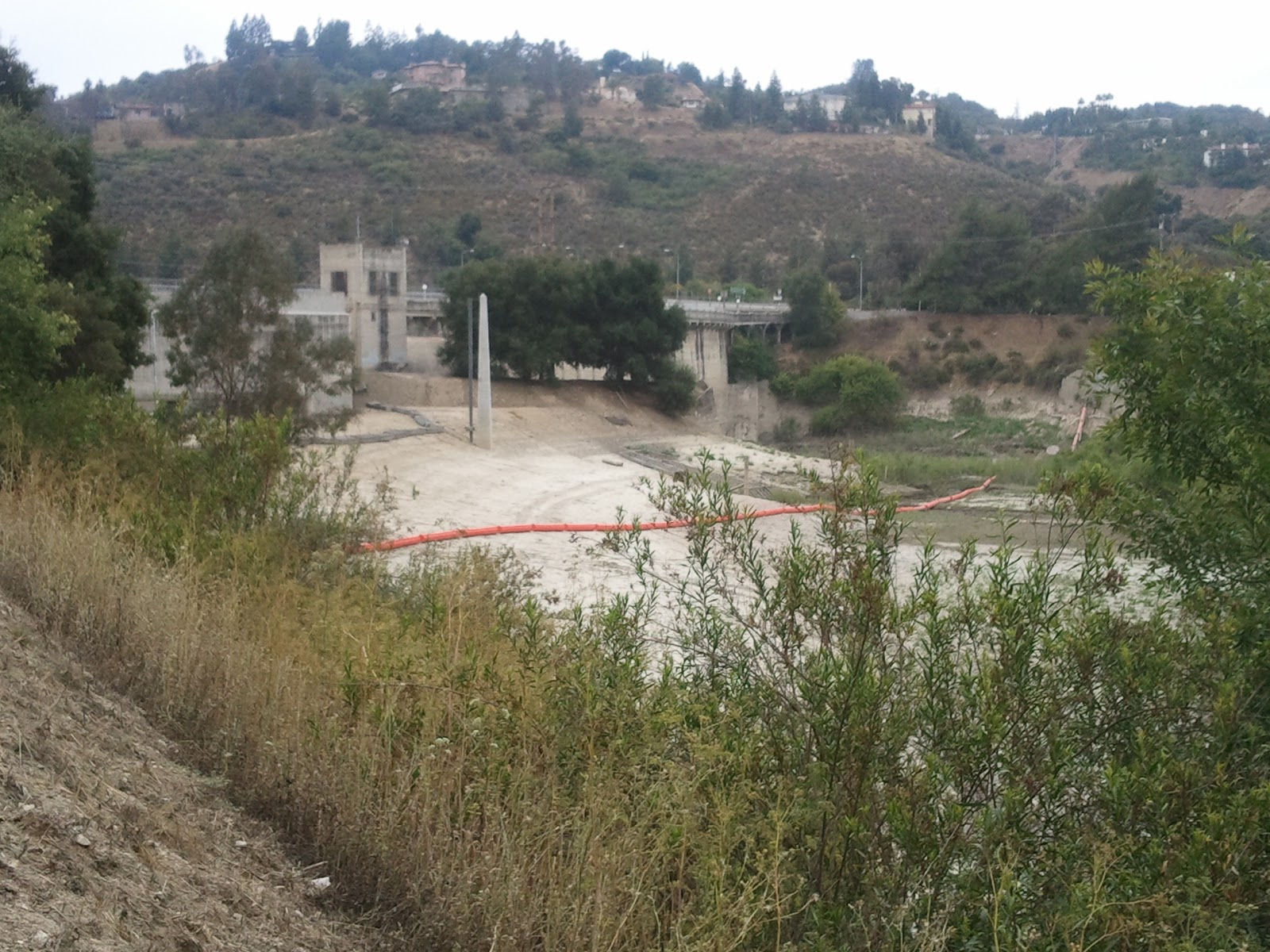
The Los Angeles County Department of Public Works has announced that it will hold two public scoping meetings as part of its preparation for an Environmental Impact Report (EIR) relative to its plan for massive sediment removal and management in 'Devil's Gate Reservoir.' Pasadenans more commonly refer to this basin as the Hahamongna Watershed Park.
The EIR preparation, a result of the County Board of Supervisors' vote a few months ago to require County staff to conduct a full EIR on the sediment removal project, rather than move forward with construction under 'emergency' circumstances, requires public scoping meetings, an initial study preparation, a public comment period, and a draft EIR report. As a general rule, this process takes about two years to complete, unless expedited.
The first public scoping meeting will be held on Wednesday, October 5th at 6:30pm at Pasadena's Rose Bowl in the Stadium Locker Room, 1001 Rose Bowl Drive (Park in Lot F, Enter at Gate C). The second scoping meeting will be held on Saturday, October 15th, at 9:00am in the cafeteria at La Canada High School, 4463 Oak Grove Drive, La Canada.
LA County has created a website that discusses both the EIR process and the current Interim Measures Project (IMP) that is removing sediment directly behind Devil's Gate Dam with sediment storage on the former Johnson Field in the Hahamongna. Click this blog's headline to be taken directly to that site.
Musings of natural and human life along the world's urban waterways, with a focus on the Arroyo Seco and Los Angeles Rivers in Southern California.
Showing posts with label Hahamongna. Show all posts
Wednesday, September 7, 2011
Tuesday, May 31, 2011
Where Should the Sediment Go? The Devil's Gate Dam Dilemma
UPDATE 8/2/2011: The Pasadena City Council unanimously approves use of Johnson Field for sediment storage during LA County's interim project to remove sediment buildup behind Devil's Gate Dam.
-------------------------------------
To understand the current dynamics playing out in the Hahamongna about sediment removal behind Devil's Gate Dam, we must look at what got us to this point.
Here's a short recap:
.The 2009 Station Fire wildfire burns almost 70% of the upper Arroyo Seco watershed, depositing over 1,000,000 cubic yards of sediment into the Hahamongna Basin, much of which collects behind Devil's Date Dam
.LA County plans to remove all sediment in the Basin under 'emergency' maintenance procedures which do not require an Environmental Impact Report
.The local environmental community protests and the LA County Board of Supervisors approves a resolution requiring a complete EIR be done before sediment removal occurs, with the exception that County Public Works can remove 25,000 cubic yards this summer directly behind the Dam because of emergency maintenance conditions.
.LA County Dept of Public Works finalizes its interim sediment measures and starts conducting community outreach meetings to review truck transportation routes to haul the sediment out of the Basin for relocation to Scholl Canyon.
.The interim sediment removal plan must be completed by October 15, 2011, when the annual rainy season traditionally begins.
Yet the controversy seems to go on....
Why?
First, while LA County has put together a generally sound interim sediment plan, it has failed in its ability to properly communicate this plan to the public. Case in point: last Thursday night's outreach meeting at La Canada High School to discuss the 'truck haul' plans. What didn't go wrong? The powerpoint did not work. There were no handouts. A new alternative #4 to keep the sediment in the Basin was announced with little context as to why this option was now being offered. Presenters seemed to be at a loss to directly answer many questions posed by the attendees.
But the enviro community and residents are not blameless here, either. Numerous bloggers, local residents and environmental organizations continue to disseminate skewed information and promote 20th Century style scare tactics online and in whisper campaigns to rally their troops towards either stopping this sediment removal or warning of 'dire' consequences if it occurs. They aren't offering any proactive alternative solutions, either.
So let's look at the facts relevant to public safety. (All these documents are online and available to the public at the dpw.lacounty.gov site.)
If you click on the header to this blog, you will be taken to the LA County Staff Report to the Board of Supervisors which accurately discusses the issues. Then take a look at the powerpoint for the interim removal plan here:
tp://dpw.lacounty.gov/wrd/removal/DevilGate/CVAC_Interim_Measures_20110525.pdf
When we cut to the chase these facts remain:
1. The sediment directly behind Devil's Gate Dam has reached a level of 1,009 feet
2. This sediment is blocking at least two sluice gates, which are responsible for releasing water through the flood gates.
3. This sediment is also close to clogging the outlet valves at the top of these sluice gates.
4. This sediment, if not removed this summer, will likely clog outlet valves, including tunnel water outlets after the next rainy season.
Clogged sluice gates and tunnel water outlets mean that the Watermaster will be unable to discharge water through the dam.
Here's the unknown: how much precipitation the Arroyo Seco watershed will get this rainy season. It's especially difficult to predict because we are now experiencing chaotic weather patterns, witnessed by Mississippi River flooding, deadly Southern tornados and a West Texas drought and fire storm. As one local example, the experts at NOAA predicted a 'dry' La Nina last year and we got instead one of the wettest seasons in recent years. Should we have another wet rainy season, even more sediment will flow into the Hahamongna, resting behind the Dam.
Based upon these facts, can we really afford to take the risk of doing nothing about sediment removal behind the Dam this summer?
Let's review the sediment removal 'haul out' options (see the map on the powerpoint link). Unfortunately, projects of this scope and type always have short-term negative impacts on the local community. Truck traffic with attendant noise over the 4 week haul out time period will inevitably be a short term nuisance to affected residents and local commuters (JPL, La Canada High students, park users).
It's totally understandable that residents are concerned about the County's initial preference to use Alternative Route #1 down Windsor Boulevard. For the County, it is the fastest route out and will require the minimal infrastructure work to get this job done. For years, these residents have dealt with the noise and congestion of heavy trucking on this roadway due to the La Vina development, the City of Pasadena's water treatment plant construction, and regular deliveries to JPL.
That's why the recent agreement between the County and the City of Pasadena Water and Power which makes the availability of Johnson Field, located on the northeast side within the Hahagmongna Basin, as a sediment removal holding site welcome news. Use of Johnson Field will decrease truck hauling by 80% since only 20% of the organic materials will have to be hauled out of the Basin itself. The remainder will be hauled to and 'stored' on Johnson Field, which has not been used as a playing field for years.
The local in-basin haul to Johnson Field will also support the short timeline the County has to move this buildup because sediment needs to be 'dried out' first before it can be relocated due of its heavy weight when saturated by water.
Ultimately, there is no solution that will make everyone 100% happy, so it's important to keep our focus on the big picture. The Hahamongna is first and foremost a flood control basin and water conservation reservoir. We continue to face dire long-term local water reliability challenges. Unfortunately, this past winter's extremely wet season has blunted our awareness that we still need to conserve water. All three of Southern California's imported water sources remain in distress. Beyond immediate public safety concerns, sediment buildup behind Devil's Gate Dam significantly reduces the amount of groundwater that can be stored for local recharge in the Hahamongna Basin.
All rivers carry both water and sediment. There is ample opportunity for all of us to work towards a fully integrated long-term strategy for sediment removal as part of the full sediment removal plan and EIR for the Hahamongna. In the meantime, let's support the interim sediment removal measures, including Johnson field Alternative #4 transport, so that our focus can be on proactive solutions for the future rather than on emergency disaster cleanup and a real risk to public safety.
Monday, May 9, 2011
The Real Hahamongna Dilemma
At first glance, you may think this photo is the Arroyo Seco flowing through the Hahamongna.
But this is actually the Arroyo Seco flowing south of Devil's Gate Dam just above Brookside Golf Course and look at that sediment!
One of the saddest legacies of the devastating 2009 Station Fire is that the complete burn of the upper Arroyo Seco Watershed created massive sediment debris flows into the central and lower reaches.
While lots of public outcry is being played out in the media about LA County's plan to remove sediment in the Hahamonga and the impact of that operation on habitat in that basin, no one is talking about what will happen downstream if the dam fails due to sediment buildup overload.
Already, heavy sediment flows into the Central Arroyo Seco have damaged most river restoration enhancements completed in 2008, including complete mortality for the small, yet growing school of native Arroyo Chub fish that was successfully reintroduced. In fact, the backwater pool under the Colorado Street Bridge is so full of sediment, you wouldn't even know that a pool once existed there.
In addition to the habitat damage, the sediment buildup both above and below the Rose Bowl complex is such that, without sediment removal behind the Dam, this popular recreation area could experience a flood or near flood event within the next year or so if rainy seasons replicate last year's deluge. Moreover, LA County's effort to relieve stress on Devil's Gate Dam from sediment buildup has included extra water releases into the Central Arroyo, contributing to the sediment buildup there.
This flooding potentiality was driven home last week during a tour by flood program representatives of the California Department of Water Resources who expressed shock (their actual word) at the level of sediment buildup behind the dam and its growing buildup in the Central Arroyo, especially as it 'backs up' into the channelized area just before the softbed section south of the Parking Lot I picnic area.
What would it mean to Pasadenans and their neighbors if the Brookside Golf Course and the Rose Bowl areas flooded?
First, it would mean no access to highly used recreational amenities, including the Rose Bowl Loop, which draw almost 3,000,0000 people to Brookside Park every year. Secondly, it would mean a major financial and logistics emergency preparedness cleanup effort by the City of Pasadena and LA County which would cost in the tens of thousands of dollars at a time of stressed public agency funding. Finally, it would mean a direct loss of over $4,000,000 in annual revenues that the City of Pasadena relies upon to fund its operating budget.
Here are some sobering facts:
.the 1938 Arroyo Seco flood damaged 85% of Brookside Golf Course and filled the Rose Bowl to its first tier level of seating until the river changed course and spared further damage to the stadium
.the Arroyo Seco Concrete Channel is nearing the end of its useful life
.the lack of federal funding match to complete the US Army Corps of Engineers Arroyo Seco Feasibility Study, first approved in 2003, hampers federal financial support for channel realignment or relocation in the Central Arroyo
.there is a high risk of little federal support in the event of a flood event in Brookside Park because, in part, the Federal Emergency Management Agency (FEMA) never created a flood inundation map for the area after the Arroyo Seco was channelized
.the Arroyo Seco Concrete Channel has never really been challenged with the type of heavy water/sediment flow now possible, so it is unknown whether it will actually 'hold' should a catastrophic spring flood event like the current Ohio and Mississippi River flooding test its strength
Let's hope that the newly created Sediment Removal Advisory Commitee will work with LA County Flood Control Management District leadership, state agencies, and federal officials to find sustainable solutions to Arroyo Seco sediment buildup that takes into account the larger context of impact that goes beyond the mere perimeter of the Hahamongna Basin.
Thursday, December 2, 2010
LA County Dumps on Oaks and Sycamores in Arcadia
In the latest version of 'your tax dollars at work,' the Los Angeles County Flood Control District intends to start to clear 11.3 acres of old-growth oak and sycamore trees in Arcadia to create a dumping area for tons of debris dredged from the Santa Anita Dam.
This planned action should alarm Southern California nature lovers for two reasons:
First, this effort destroys a historic plantation of trees whose growth has taken decades to achieve in an area quickly losing tree canopies.
Secondly, this plan sets a precedent that could lead to similar old growth tree destruction in the Hahamongna Watershed Park in Pasadena next year when the County uses 'emergency funds' from FEMA to remove 1.2 million cubic feet of sediment from behind Devils Gate Dam.
Fortunately, open space activist Christle Balvin and the Sierra Club 'got wind' of the County's plan and have requested a meeting with the County to discuss alternatives to this tree removal.
And they need your help, to prove to the County that these trees matter. They've arranged an 'inspection tour' of the sediment disposal site for Saturday, December 4th at 9:30am at the end of Elkins Avenue in Arcadia. This is a case where body count may be the difference in protecting tree count. For more information, call 626-476-7324.
Saturday, November 21, 2009
Heroes of the Hahamongna - One in a Series
Growing up in the Adirondacks of Upstate New York gave Mary Barrie a natural affinity for the mountains and nature. Perhaps that's one reason why when she and her family moved to Southern Califoronia, they settled in the San Gabriel Mountains foothills of La Canada-Flintridge.
An avid hiker, dog walker and equestrian, Mary began exploring this natural wonderland on its many varied trails and byways. These walks brought her to a meeting of the La Canada-Flintridge Trails Council, where she quickly became involved with numerous trail clearance and restoration projects.
Shortly thereafter, Mary's family became involved with Rose Bowl Riders, which for years has been a tenant of the City of Pasadena with stables, riding ring and clubhouse in the Hahamongna Watershed Park.
Many people may not know this, but the Hahamongna is almost a grand hub for hiking and horse trails that wind northward into the Angeles National Forest and southward along the scenic Arroyo Seco River into South Pasadena.
Throughout the past 21 years, Mary has watched the changes happening in the Hahamongna Basin: the closing of the gravel pit operation and the creation of the Hahamongna Watershed Park, along with the adoption of the Hahamongna Master Plan, an element of Pasadena's Arroyo Seco Specific Plan. http://bit.ly/8wwmVp
As meetings and discussions grew about the future uses of the Hahamongna and the Hahamongna Annex, Mary quickly moved into activist mode, using her skills as a law librarian to research both the history of this natural basin and the myriad of planning and legal documents its potential future has engendered.
Why such vigilance? Because Mary believes that the Hahamongna Watershed Park is a special rustic expanse that should not be developed and that every little 'modification,' whether a new road here or the cutting of major trees there, can easily lead to the 'slippery slope' of massive real estate development. She also wants the City to implement the Master Plan that's been officially approved and is concerned about how plan elements are being nibbled around the edges by proposed staff modifications not formally adopted within the Master Plan approved by the Pasadena City Council in 2003. When discussing her passion for Hahamongna, Mary notes the many efforts over the past century to construct everything from amphitheatres to museums on this unique parcel, which also plays a key role in the City of Pasadena's water future due to its storage capacity behind Devil's Gate Dam and its spreading fields.
Even if you haven't met Mary, you probably already know her if you attend any community or city commission/council open space, environmental, or recreation meetings in Pasadena and La Canada-Flintridge. Yes, she is relentless. Yes, she sometimes irritates people because she can be seen as an obstructionist to 'progress.'
But Mary is passionate about the Hahamongna and this passion keeps her vigilant even after 10 long years of activism. For Mary is not looking at just the Hahamongna of today ~ she sees herself as a just another person in a long continuum of community leaders who have helped Hahamongna beat the odds for over a century and remain a beautiful expanse of natural, biodiverse open space where people can enjoy passive recreation through hiking, picnicking, horseback riding, disc golf, and just sitting and meditating among the beautiful, mature grove of oak trees.
Mary's forward vision and activism to keep the Hahamongna rustic for future generations is why she is a Hero of the Hahamongna.
Friday, May 22, 2009
Heroes of the Hahamongna - One in a Series

No river restoration effort is successful without the ongoing stewardship of individuals, school groups, youth organizations, retirees and community groups who work hard to keep urban and suburban environments natural.
These people and organizations are often unsung heroes who, little by little, contribute to the tremendous work necessary, especially in an urban watershed, to both restore AND maintain its beauty for future generations.
One such hero is Roger Klemm, who has been nurturing oak seedlings that will soon be planted in the Hahamongna Watershed Park in Pasadena. Roger visits and enjoys the Hahamongna often, since he works at nearby NASA/JPL and his son participates in the Tom Sawyer Camp which uses part of the Park for its youth activities.
One day, while walking throught the Equestrian Staging Area of the Hahamongna, Roger noticed two Englemann Oak trees and was inspired to help keep Hahamongna full of native trees for future generations by gathering acorns and nurturing seedlings.
Now, his seedlings of Englemann Oak and California Coast Live Oak are being readied for planting in the Hahamongna this summer, where young day campers, including his son, will nurture their new growth during those first few critical months of ‘taking’ to their new home.
Learn more about the Englemann Oak here: http://www.arroyoseco.org/eoak.htm.
Roger’s personal passion means that new tree life will continue on in the Hahamongna. Just as importantly, he is passing on the legacy of environmental stewardship to the next generation of Californians.
Thanks, Roger, for your small part in restoring our riparian habitat
Subscribe to:
Posts (Atom)